Mobile · Cross border commerce
MoveOn: Global Shop & Shipping
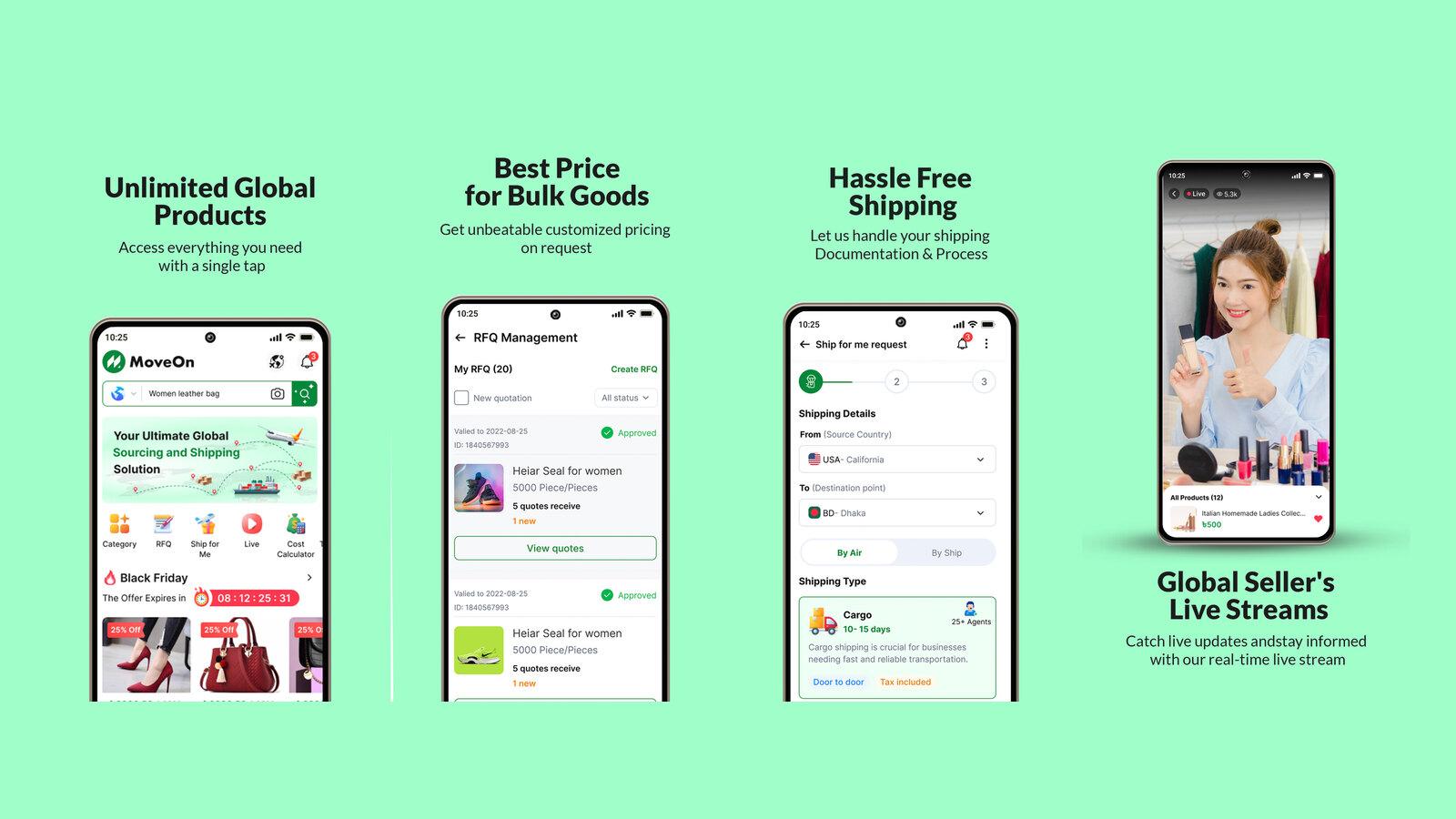
MoveOn's flagship cross border commerce app, where customers shop international stores and ship to Bangladesh.
- Role
- Mid Level Software Engineer
- Timeline
- Feb 2026 to present
- Type
- Mobile · Cross border commerce
- Company
- MoveOn Technologies Ltd.
What the product does
MoveOn is cross border commerce for Bangladesh. A customer finds a product on an international store, MoveOn buys and imports it, and the parcel arrives at their address. The app carries the whole journey: discovery, ordering, payment, and the long tail of status updates that follow.
What I own
Two pieces of work, both of them on the parts of the product customers feel first.
The AI assistant. I am one of the core engineers on the in-app assistant. It exists because cross border shopping produces a specific kind of confusion: is this the right product, how do two listings compare, what will this actually cost me landed, and why has my order not moved. Those questions used to go to a support agent. Now most of them do not have to.
The assistant is not a chat box wrapped around a model. It calls the same product, pricing and order APIs the app uses, through function calling, so its answers come from the system of record rather than from the model's memory. Context is assembled per turn: who is asking, what they are looking at, what their recent orders are. That framing is the difference between an assistant that is useful and one that is confidently wrong.
Performance. I led the work to make the app lighter and faster: install size, cold start, image and cache behaviour, memory under long browsing sessions, and the order placement path specifically. The target was never a benchmark. It was that the app stays responsive on a mid range Android phone on a weak connection, because that is what the customer base is holding.
The part worth stealing
Treat an in-product assistant as an API client with a language interface, not as a knowledge base. The moment it answers from its own memory instead of your data, it will eventually tell a customer something about their order that is not true, and you will spend more on that one message than the feature saved.
Going deeper
There is a full case study for this project: context, architecture, trade-offs and what I would change today.
Read the case study