Mobile · Cross border commerce
Ali2BD: Global Smart Shopping
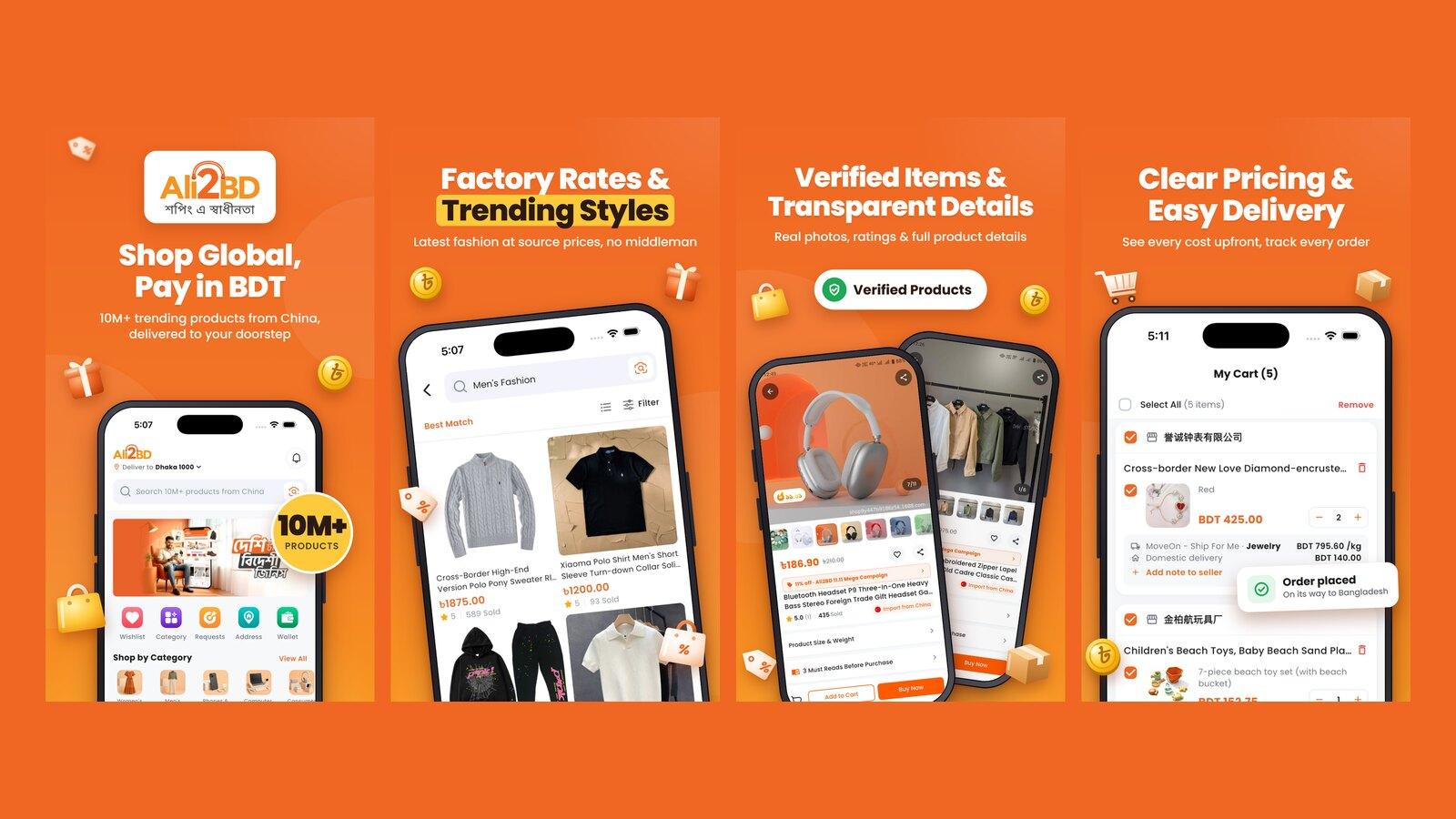
Cross border shopping app that lets customers in Bangladesh buy from international marketplaces and track the parcel to their door.
- Role
- Technical lead, mobile
- Timeline
- 2026
- Type
- Mobile · Cross border commerce
- Company
- MoveOn Technologies Ltd.
What the product does
Ali2BD is how customers in Bangladesh buy from international marketplaces. They search a foreign catalogue in the app, place an order in taka, pay locally through bKash or a card, and follow the parcel from the seller's warehouse through customs to their address.
What I owned
I was the technical lead for the mobile application. That meant the architecture, the release process and the calls that were mine to make, not only the code I wrote.
Specifically:
- Designed the application structure and set the conventions the team built against.
- Designed the interface and the ordering flow, then implemented it.
- Owned two backend features end to end: the notification pipeline and bKash tokenized payments.
- Took the app through its first release on Google Play and the releases after it.
The engineering
Payments. bKash tokenized payment lets a customer save their account so the next order is two taps instead of a full re-entry. That convenience is a security decision in disguise: what you store, what you never store, and how you prove a payment actually happened before an order is marked paid. The rule I built to was simple. The app holds nothing. The server holds a token that is useless anywhere else, and an order becomes paid only after a server to server verification, never on a client callback.
Notifications. Order status is the reason people open a cross border shopping app. Delivery goes through Novu, which fans a single event out to Firebase Cloud Messaging, APNs, email and SMS, so channel logic lives in one place instead of scattered through feature code. Device tokens are tied to login sessions, which is what stops a shared phone from pushing one customer's order updates to another.
Replacing a live system. The hard part was never the new code. It was that the old system had customers in it, mid order, who did not ask for a new app.
What I would do differently
Set up release telemetry before the first launch, not after it. We shipped, then wanted to answer questions the build could not answer yet. Instrumenting a flow after it is live is always slower than instrumenting it as you build it.
Going deeper
There is a full case study for this project: context, architecture, trade-offs and what I would change today.
Read the case study