Mobile and backend · Community operations
Nirbhor
Shared flat management for bachelor housing: meals, expenses, wallets, tasks and a settlement engine that closes the month without an argument.
- Role
- Sole engineer
- Timeline
- 2026
- Type
- Mobile and backend · Community operations
- Company
- Independent product
What the product does
Bachelor flats in Bangladesh run on shared money. Rent is split, a cook is paid, someone buys groceries, meals are counted per person per shift, and at the end of the month somebody sits down with a notebook and works out who owes what. That last step is where the friction lives, and it is almost always the same person doing it.
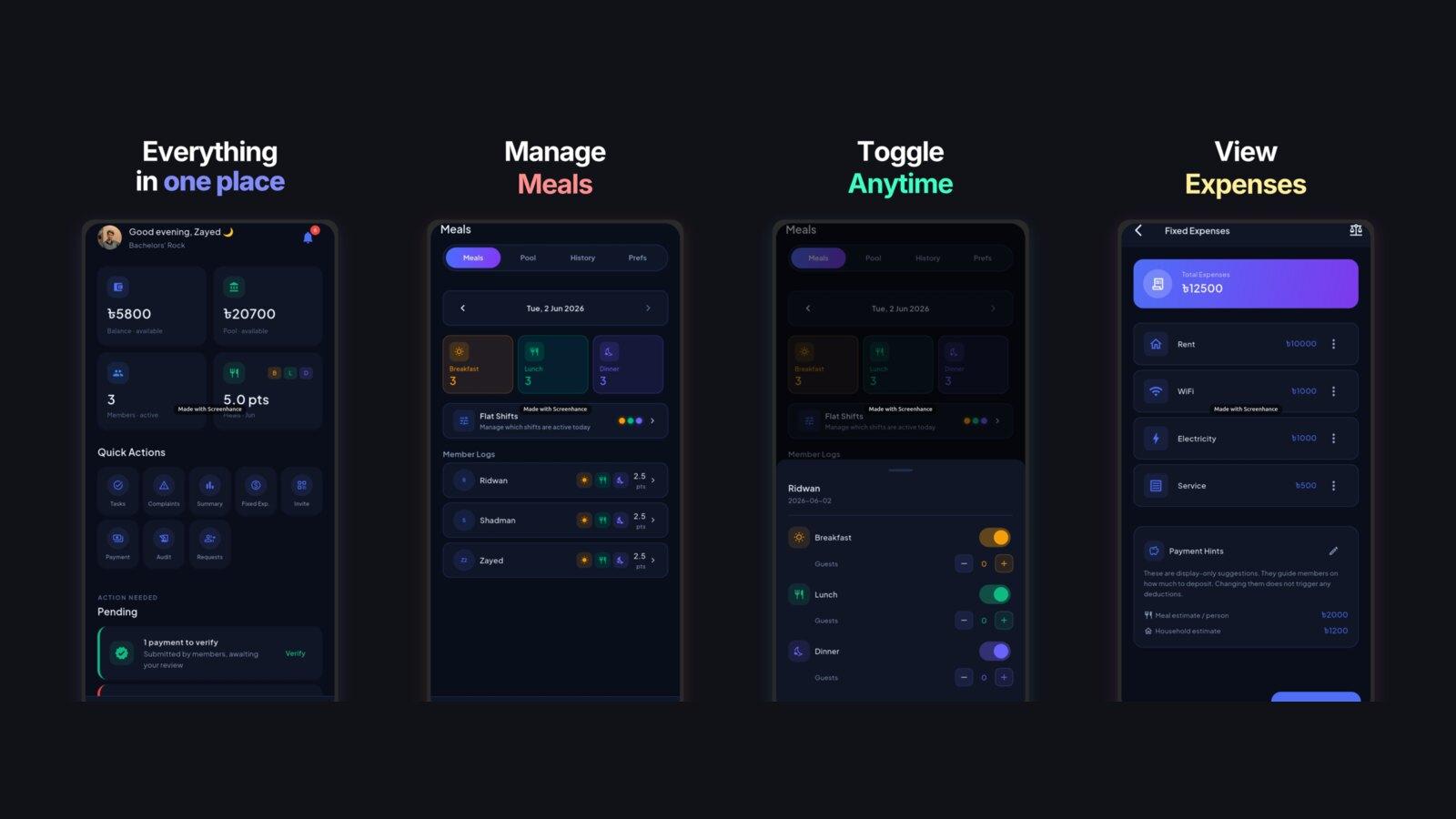
Nirbhor replaces the notebook. Members mark the meals they will eat, expenses are recorded and approved, wallets track contributions, and at month end the system closes the books and tells every member exactly what their number is and how it was reached.
What I built
The Flutter application, the Node.js and Express API, and the PostgreSQL schema. Twelve modules: auth, flat, member, meal, wallet and payment, expense, task, complaint, notification, audit log, monthly summary and feedback.
Both halves are open source: the Flutter app and the API, which has 128 automated tests.
The interesting engineering
Meal cost is a pool, not a price. Nobody knows what a meal costs until the month is over. Members accumulate points per shift, the flat accumulates grocery expenses, and the cost per point only exists at close: total expense divided by total points. Everyone is then charged their own points at that rate. It is the correct model and it means the system has to be honest about the fact that a number is unknowable until it is not.
Rounding has to add up. Split 1,000 taka across three members and naive rounding loses or creates a taka. Every distribution floors each member's share and gives the remainder to the flat manager, so the parts always sum to the whole. Small detail, and the first thing a user notices when it is wrong.
A settlement lock, not a soft warning. When a member starts the exit process, their balance is being calculated. Letting them add expenses mid calculation would make the settlement meaningless, so a middleware returns 423 Locked on anything that would move their numbers, while still allowing payments. The lock is enforced at the edge, not inside each service, so no future endpoint can forget about it.
Money moves inside transactions, always. Approving a household expense debits every active member's wallet, debits the flat wallet, writes a transaction row per member and writes an audit log entry. That is one Prisma transaction or it is nothing. The audit helper takes the transaction client on purpose, so the log cannot survive a rollback of the thing it describes.
Going deeper
There is a full case study for this project: context, architecture, trade-offs and what I would change today.
Read the case study